Natural Birth Doesn’t Happen by Accident!

At least not in the North American Medical Model, in which the great majority of people give birth. It requires intentional preparation and planning. 

Here are Seven Ways to Help Make A Natural Birth Happen:  

  1. Strong determination and mind-set. Birth requires us to dig deep.
  2. Intentional and deliberate preparation and planning
    1. Get informed through good prenatal classes, positive stories to find the faith
    2. A solid birth-plan that communicates your wishes
    3. Learn how the female body works in the birthing process
    4. Understand what makes the pain or intensity of labour increase and decrease
    5. Dealing with past trauma might be required
  3. Advocacy 
    1. Asking questions to make informed choices 
    2. Saying no; being prepared to say no over and over if needed
  4. Tools to deal with intensity
    1. E.g. hypnobirthing, meditation, mindful yoga practise
    2. Positions that help
    3. Touch / massage
    4. Setting the tone in your birthing space
    5. TENS machine
    6. Water – bath, birth-pool (natures epidural)
  5. Dream-Team helps a lot
    1. Support person(s) that:
      1. Are a loving and/or grounding presence 
      2. Aren’t afraid of a birthing person’s pain, sounds, behaviours
      3. Know how to provide comfort
      4. Will advocate for you
    2. Doulas – research shows the presence of a doula leads to:
      1. Shorter and less complicated births
      2. Half the rates of caesareans
      3. Significantly fewer requests for pain meds
      4. Significantly more eye contact and touch between the labouring person and their partner
    3. If giving birth in the medical model, a medical care provider who supports natural birth. Ideally: 
      1. You know them
      2. You feel comfortable with them
      3. Will respect your decisions
      4. Offer shared decision making / informed choice
      5. Their methods and ideas about birth gel with yours
  6. Baby being in the optimal fetal position before labour starts
    1. Big factor in determining length of labour and intensity
    2. Factor in some interventions being used
  7. Some good luck!
    1. Health of mother and baby going into labour
    2. Medical care provider working that day
    3. When labour starts
    4. How long it lasts
  8. Allow labour to start naturally. An induced labour is a completely different experience, usually more painful and birth turns into a medical event. Barring medical reasons, be patient and wait for labour to start on its own. 

No matter how labour goes or what interventions are, or are not used, birth is hard work –  physically, mentally, emotionally and spiritually. But women have been doing it for millennia and you can too!

Angie The Doula – Warning Signs During Pregnancy and Labour

Unusual sensations and some discomforts are part of normal pregnancies.  It is important, however, that any of the signs listed below be assessed right away.

CALL 811/DOCTOR/MIDWIFE WITH ANY WARNING SIGNS.  CALL 911 FOR EMERGENCY HELP!

If you call 911, have someone clear a path for EMT (halls, stairs etc), turn on outside light, put pets away, unlock door, clear driveway.)

Warning Signs – Seek medical advise soon, at least same day. Do not sleep on any of these or wait for them to go away on their own.

  • Reduced fetal movement that doesn’t respond to stimulation (see below) *
  • Maternal fever and chills
  • Dizziness
  • Persistent and severe mid-back pain
  • Prolonged nausea and vomiting
  • Initial outbreak of lesions or blisters in the perineal area
  • Change from normal urination – suspected bladder infection
  • Vaginal discharge with itching, irritation or a foul smell
  • Signs of bladder infection such as burning or urgent, frequent urination
  • Persistent negative feelings, low moods and/or overwhelming anxiety.
  • Gush of vaginal fluid or suspect ruptured membranes, with nothing felt to be falling out
  • Pinkish, brownish, sparse or suspected vaginal bleeding
  • Signs of labour (regular uterine contractions, waters releasing) before 37 weeks
  • If there’s a colour (yellow, brown, green) or foul odour when waters release

Danger Signs – The symptoms below may indicate a life-threatening condition, and require immediate medical attention.  Get to a hospital right away.

  • Accident or injury such as car accident or a fall (seek medical attention if required)
  • Sudden severe swelling of hands and face
  • Severe continuing headache
  • Visual disturbances (e.g., blurring of vision, spots, flashes of light)
  • Persistent, severe, sudden abdominal or pelvic pain
  • Severe epigastric pain (upper abdomen) – may feel like heartburn but more severe and not relieved by the usual tricks
  • Sudden and severe vomiting
  • Red flowing vaginal bleeding (CALL 911)
  • Persistent thoughts of self-harm, suicidal urges (CALL 911)
  • Convulsions (CALL 911)
  • Gush of vaginal fluid / suspected ruptured membranes, with a cord felt at or outside vaginal opening (cord prolapse) – get on hands and knees with buttocks higher than head (CALL 911)
20200408_121420

* Normal Fetal Movement:  If you’ve been busy or are unsure about movement then relax and have a meal, a small glass of juice or some fruit.  Palpate your baby to induce movement.  Pay attention to the movements.  Babies sleep.  If your blood sugar is low then so is your baby’s.  You should feel at least 10 movements over any 2 hour block and at least 1 in the first hour.   If not then seek medical attention.

Updated RGH policies for maternal patients and what doulas can do for you

As of April 2, 2021, RGH and all Sask hospitals are now closed to visitors and are restricting support to only ONE person in the Labour & Birth Unit and the Mother-Baby Unit. Each labouring woman can have one person with her throughout her stay; the same one person, no swapping or changing. The restrictions also affect patients in pretty much every unit throughout all hospitals.

The Sask Health Authority will re-evaluate weekly and get back to 2 support persons as soon as they deem it safe to do so. My fingers and toes are crossed that this happens before your birth! If it doesn’t, doulas are still here to help you.

I have been down this road a year ago for about 2 months with several clients and can still be immensely helpful to you. Here’s what doulas can do to help you prepare for your birth during this time:

  • Extra planning and education for your birth, given this new situation.
  • Answer your questions through pregnancy, birth and postpartum. You still have someone you can call anytime.
  • Early labour support in your home, while wearing masks.
  • Help you make the decision about when to go to hospital. We can do this by phone or in person.
  • Ensure you know which door to use, where to park, what you need to go through registration and admitting.
  • Be your back-up for support in case one of you “fails screening”. 
  • Be the primary support person if wanted or needed.
  • Phone and/or video support throughout your labour and birth. This works best if you resist the urge to “be polite and let your doula sleep”. If I have updates throughout your journey, I can advise you on questions to ask, positions to try, things to do for comfort, things to do to keep labour progressing as well as possible. I can watch for “cross roads” and help you towards what is your version of an ideal birth. I can still help you navigate detours. I supported 7 couples in this manner in 2020 and they were grateful for the guidance, even though it looked differently than we had originally planned.
  • Postpartum support will be offered as usual – at your home, by phone or video call – your choice. 

Here’s what you can do to make your birth as empowering as possible for both of you:

  • Extra planning and education, with a doula’s help.
  • Have a good solid birth plan.
  • RGH Tour with me
  • Easing Labour Pain class, which teaches partners how to do hands-on support. It also covers informed choice and many options for comfort and labour progress.
  • Print, read and bring to your birth Hospital Set-up 101. There’s a link to a YT video if you prefer that.
  • Check out my article, When to go to Hospital
  • Lots of communication with your doula!

My mantra lately, even with this latest development, is “everyone is doing the best they can”. The new restrictions are certainly frustrating (to say the least) and inconvenient but our health care providers are working hard to find the balance of patient safety and patient experience.  My fingers are crossed that this phase passes quickly and we can get back to our regular routines of attending hospital births in person. That said, I’m so sorry about the effect this has on your birth plans. Even if things change before you go into labour and we can be together in person, it does mean extra preparation and stress for you.

Please let me know if you have any questions. I am here to help.

I teach a variety of Child Birth Education classes and prenatal workshops online for people all over.  I have been a birth doula since 2002, and have helped over 300 clients with their births and over 1000 through prenatal classes. Learn more about my birth doula services, and contact me with any questions you may have.

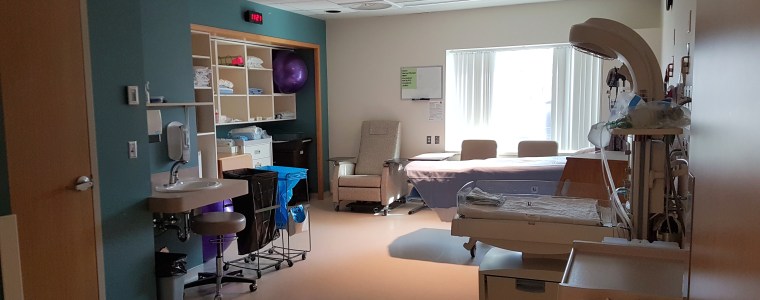
Hospital Birth Room Set-up 101

One of the important tasks I do for my clients is to set up their hospital birth room for comfort, safety and efficiency.  Here’s a list of what I take care of I go into a birth room.  In my local hospital the birth rooms all have a small closet, mini-fridge, blanket-warmer, some empty shelves and an adjoining private washroom with a tub. If you’re DIYing then find out ahead of time what your local birth rooms are like and modify as needed.